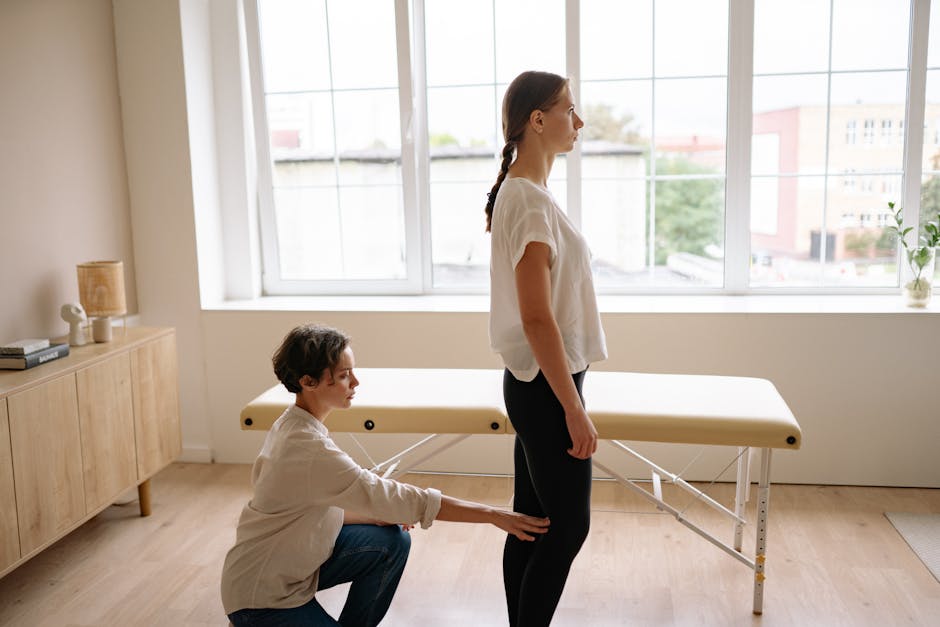
Searched for structural integration for posture in Boston? While Rolfing® is a trademark of The Rolf Institute, Joel Gheiler practices the original Rolf Method of Structural Integration — the lineage Dr. Ida Rolf taught her senior students — including Emmett Hutchins, who later founded the Guild for Structural Integration where Joel trained directly under him — before her work was formalized as Rolfing®. Here’s how it addresses postural alignment:
Posture Is Not What You Think It Is
If you have ever been told to "stand up straight," you already know how useless that advice is. You can pull your shoulders back, tuck your chin, and engage your core — and within five minutes, you have drifted right back to wherever your body naturally wants to be. This is not a failure of willpower. It is a failure of understanding what posture actually is.
Posture is not a position you hold. It is a relationship between your structure and gravity. And that relationship is determined not by your muscles, your awareness, or your discipline, but by the organization of your fascial web — the continuous sheet of connective tissue that shapes and supports every structure in your body.
This was Dr. Ida Rolf's fundamental insight, and it remains the foundation of the Rolf Method of Structural Integration that I practice in Boston through the Guild for Structural Integration — distinct from DIRI's modern Rolfing® system, and preserved as Ida taught it in her final years specifically because her postural insights were so dependent on the original sequencing. She understood that posture is a structural question, not a behavioral one. And she developed a systematic method for answering it.
Why Exercises and Reminders Do Not Fix Posture
The fitness and wellness industry is full of posture correction programs. Strengthening exercises for the upper back. Stretches for the chest. Apps that buzz when you slouch. Ergonomic chairs and standing desks. These approaches all share a common assumption: that poor posture is caused by weak muscles, tight muscles, or bad habits.
But here is the problem. If your fascia has shortened and thickened along the front of your body — pulling your shoulders forward, rounding your upper back, and tilting your head ahead of your spine — no amount of strengthening the muscles of your upper back will override that fascial pattern. You are trying to use muscle force to fight against the structural fabric of your body. The fabric always wins.
Dr. Ida Rolf put it more directly: you cannot change the position of the body's segments without changing the medium in which those segments are suspended. That medium is fascia. And changing fascia requires hands-on work — skilled, systematic, and informed by a deep understanding of structural relationships.
The Modern Posture Crisis
If posture was a problem in Dr. Rolf's time, it has become an epidemic in ours. The amount of time the average person spends sitting — at desks, in cars, on couches, hunched over phones — has created a generation of bodies organized around flexion. Forward-head posture. Rounded shoulders. Collapsed chests. Shortened hip flexors. These patterns are so common that they have earned their own names: tech neck, text neck, desk posture.
What most people do not realize is that these are not just muscular habits. They are fascial adaptations. The connective tissue has literally reshaped itself to accommodate the postures you spend the most time in. After months and years of sitting in flexion, the fascia along the front of the body shortens and thickens, while the fascia along the back lengthens and weakens. The result is a structural pattern that persists whether you are sitting at your desk or standing in line at the grocery store.
As I discuss in my article on Structural Integration for neck pain: The Rolf Method, forward-head posture is one of the most common sources of chronic neck tension and headaches. But treating the neck alone misses the point. The head is forward because the entire front line of the body has shortened. The solution must address the whole pattern.
How the Rolf Method Creates Lasting Postural Change
The Rolf Method addresses posture at its source: the fascial web. Rather than telling you to hold a position, we change the structural relationships that determine where your body naturally falls in gravity.
This work proceeds systematically through a series of sessions. In the early sessions, we address the superficial fascial layers — opening the chest, freeing the breath, creating length in the front of the body. As the series progresses, we work with deeper layers — the core fascial structures that support the spine, pelvis, and cranium.
The result is not a posture you have to maintain consciously. It is a posture that happens naturally because the structural relationships supporting it have changed. Clients regularly describe the experience as feeling taller, lighter, and more at ease — not because they are trying to stand differently, but because their body has been reorganized to find its natural alignment in gravity.
Ida Rolf's Insight About Gravity and Posture
Dr. Ida Rolf's most profound contribution was recognizing that gravity is not the enemy of posture — it is the key to it. A well-organized body does not fight gravity. It is supported by gravity. When the major segments of the body — feet, legs, pelvis, ribcage, head — are stacked and balanced, gravity flows through the structure like a column, providing effortless support.
This is what distinguishes the Rolf Method from every other approach to posture. We are not trying to oppose gravity. We are reorganizing the body so that gravity becomes an ally. When the fascial web is balanced and the segments are aligned, standing upright becomes the path of least resistance — not the result of muscular effort.
What Changes Look Like
Clients who come to me seeking help with posture in Boston — whether they are dealing with rounded shoulders, forward-head position, or a general sense of collapse and compression — typically notice changes within the first few sessions. The breath opens. The chest lifts without effort. The head begins to find its natural position over the spine.
Over the course of the full series, these changes deepen and stabilize. The body finds a new structural equilibrium — one that is supported by the fascial web rather than maintained by muscular effort. This is why the changes from Structural Integration last months and years rather than hours. The structure itself has changed.
If you have spent years trying to fix your posture through exercises, reminders, or gadgets without lasting results, the issue is almost certainly structural. The Rolf Method addresses posture at the level of the fascial web — the level where the pattern actually lives. The work is precise, systematic, and grounded in Dr. Ida Rolf's original approach to organizing the body in gravity.