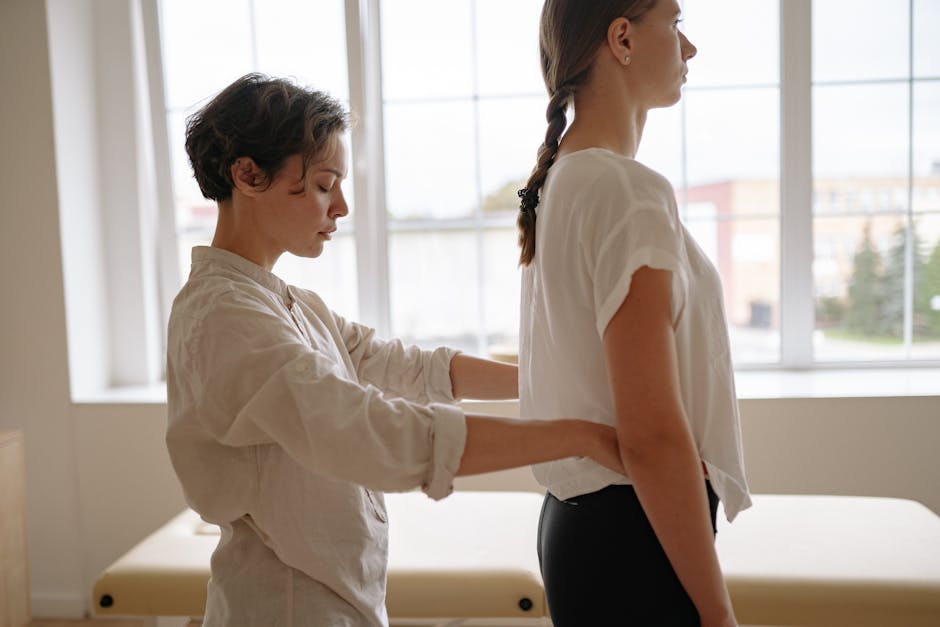
Searched for The Rolf Method and the Line? While Rolfing® is a trademark of The Rolf Institute, Joel Gheiler practices the original Rolf Method of Structural Integration — the lineage Dr. Ida Rolf taught her senior students — including Emmett Hutchins, who later founded the Guild for Structural Integration where Joel trained directly under him — before her work was formalized as Rolfing®. Here’s what The Line means in her work, and why it matters:
When Dr. Ida Rolf developed her method, she introduced a powerful concept known as the Line. This idea sits at the heart of Structural Integration, myofascial release, and somatic therapy — a map for understanding how the body organizes itself within gravity.
The Body as a Web of Relationships
Dr. Rolf understood that the body is not simply a collection of parts. It is an interconnected web — a system of bones floating in an ocean of myofascial tissue. Fascia surrounds and connects every muscle, bone, and organ, forming a dynamic network that shapes posture, movement, and sense of self.
While fascia is fluid and adaptable, bones and organs provide structure and weight. The ultimate organization of the body is deeply influenced by gravity. The goal in the Rolf Method is not to fight gravity The goal in the Rolf Method is not to fight gravity, but to organize the body so gravity becomes a supportive force. This emphasis on emergent organization — rather than corrective alignment — is one place where the original Rolf Method differs from common patterns I see in modern Rolfing® practice, where protocols can take precedence over Ida's principle of letting the Line reveal itself., but to help the body organize itself so gravity can flow through it with minimal strain.
When organization is lost, gravity works against you.
When the body is well organized, gravity travels through the myofascial system in a way that minimizes stress on joints and connective tissues. When that organization breaks down, gravity moves unevenly — creating areas of tension, compression, or instability.
Pain, Fascia, and Structural Adaptation
Many people arrive with pain that has developed over time. When pain arises — whether from injury, structural imbalance, or emotional stress — the body adapts.
Over time, the myofascial network can harden, shorten, or reorganize itself around protective patterns. Fascia begins pulling on bones differently, altering posture and movement. Gravity may then bypass certain areas or load them excessively.
This creates a chain reaction. If gravity avoids one area, another must compensate. If gravity compresses one region, other structures strain to support it.
Where Is the Line?
The Line can be understood as a vertical pathway running through the center of the body. It begins at the top of the head, passes slightly in front of the spine, moves through the diaphragm, and continues downward through the pelvic floor.
Rather than being a rigid structure, this Line is an approximation — a functional pathway through which gravity ideally travels.
The roof of the mouth — connected to the base of the skull and sphenoid, influencing how the head sits on the spine
The respiratory diaphragm — coordinates breath and spinal movement, central to how the torso organizes
The pelvic floor — an inverted diaphragm supporting the organs of the pelvis, foundational to core stability
When these structures begin to coordinate and balance with each other, the body often finds a more vertical, effortless organization.
Length, Span, and Movement
A key principle is restoring the natural span of the body. Bones function best when they are free to express their full length, and muscles work most efficiently when they can lengthen and contract fluidly.
Healthy movement relies heavily on eccentric lengthening — the controlled lengthening of muscles — rather than constant contraction. When the myofascial system regains its elasticity, the body gradually becomes capable of allowing gravity to pass through the central Line.
This does not mean standing stiffly upright. It means the body can dynamically organize itself in response to movement and environment.
Beyond Biomechanics
The concept of the Line extends beyond structure. The body is not only a mechanical system — it is also an emotional and neurological one.
As the Line begins to emerge through careful work, clients often experience not only physical shifts but emotional and neurological changes as well. The practitioner's task is not to force the body into alignment but to coax the tissue into relationship.
Allowing the Line to Emerge
One of Dr. Rolf's most important insights was that the Line should emerge relationally, not be imposed mechanically. Each person's structure is unique, and their history — physical and emotional — lives within their tissues.
By maintaining a wide awareness of the whole body while working with specific fascial relationships, the practitioner helps clients reorganize both physically and neurologically.
When the Body Finds Organization
The ultimate goal is not posture correction. It is the emergence of ease — a state where structure, movement, and nervous system regulation support one another.
gravity is no longer something we fight.
It becomes the very force that supports us.
And within that support, the Line quietly does its work.